Low-Iron Glass Guide — Extra Clear Glass vs Standard Float
Standard float glass carries a hidden ingredient that tints every edge green: iron. Low-iron glass removes it — and with it the question "is the upgrade visible from where I stand?" This guide compares the two on seven properties, shows exactly where the difference earns its 30–60% premium, and where it buys you nothing.
| Property | Standard clear float | Low-iron | Tempered low-iron |
|---|---|---|---|
| Iron content (Fe₂O₃) | 0.08 – 0.12% | < 0.01% 🏆 | < 0.01% |
| Light transmission (4 mm) | ≈ 88–89% | ≈ 91–92% 🏆 | ≈ 90–91% |
| Edge color on thick sections | Green cast | Near colorless 🏆 | Near colorless |
| Strength (relative) | 1× (annealed) | 1× (annealed) | 4–5× (tempered) 🏆 |
| Break pattern | Sharp shards | Sharp shards | Small dice, safe 🏆 |
| Can be cut after treatment? | Yes 🏆 | Yes | No — cut first, temper second |
| Cost vs standard clear | 1× baseline 🏆 | 1.3 – 1.6× | 1.8 – 2.6× |
Clarity is one input; the other is thickness. Whichever glass you choose, the Glass Table Top Calculator sizes tops and overhangs, the Aquarium Glass Thickness Calculator sizes tank panes by water depth, and the main calculator on the home page converts any of those panels into a weight — because low-iron weighs exactly the same as the glass it upgrades.
What Is Low-Iron Glass?
Glass is made from sand, and most sand contains iron. In standard soda-lime float glass, iron oxide makes up roughly 0.08–0.12% of the melt — a trace, but a chemically opinionated one: iron absorbs light at the red end of the spectrum, so whatever passes through skews toward blue-green. Look through a single 4 mm window pane and your eye compensates; look across a thick edge, a deep tank or two stacked panes, and the accumulated absorption reads as an unmistakable green.
Low-iron glass — sold under brand names like Starphire, Optiwhite, Diamant and UltraClear — is float glass made from selected low-iron silica with iron content below 0.01%, roughly a tenth of the standard batch. The mechanical properties are unchanged: same density (2.5 g/cm³), same weight per millimeter (2.5 kg/m²), same strength, same workability. The only thing that changes is color fidelity — light transmission rises from about 88% to about 91–92% at 4 mm, and the difference compounds with thickness the way interest compounds with time.
 Reef tanks: the flagship low-iron applicationPhoto: Unsplash
Names It Goes By
- → Low-iron glass / extra-clear glass (industry)
- → Ultra-clear, water-clear, crystal glass (retail)
- → Starphire® (Vitro), Optiwhite™ (Pilkington), Diamant® (Saint-Gobain) (brands)
- → Starphire / optiwhite (aquarium hobby shorthand)
- → Vidrio bajo en hierro / vidrio ultraclaro (Spanish)
All describe the same material class. Verify by the two numbers that matter: Fe₂O₃ < 0.01% and light transmission ≥ 91% at 4 mm.
Low-Iron vs Clear Glass: The Green Tint, Shown
The tint scales with total glass thickness between your eye and the subject. The same pane is invisible at 4 mm and wine-bottle green at 12 mm — which is why the upgrade decision is really a thickness decision. Read the bars below as how much green accumulates at each common panel type.
Green Cast by Application — Standard Glass vs Low-Iron
✅ The visible test in a shop: look at the polished edge of any thick sample against white paper. Standard float glows green within seconds; low-iron stays near-colorless. This 10-second test settles more arguments than any datasheet.
❌ Don't buy low-iron for: windows you'll dress with curtains, tinted or textured privacy glass, and any application where the substrate sits behind film or coating — none of these let the clarity reach your eye.
When Low-Iron Glass Is Worth It — and When It Isn't
The premium buys color fidelity. Whether color fidelity matters depends on what the glass shows and how thick it is. Six applications, ranked by how visibly the upgrade pays for itself:
Aquariums & reef tanks
Water itself tints blue-green; a standard glass face compounds the shift and mutes coral color. Low-iron keeps livestock colors honest on rimless builds where the pane IS the aesthetic.
Museum & display cases
Curators specify low-iron + anti-reflective laminate because color fidelity of artifacts is the entire point. Standard float visibly shifts whites and blues behind two extra sheets.
Glass table tops (thick)
A 1/2" edge in standard glass reads strongly green. The same top in low-iron shows a water-clear edge — the reason designer tables spec it by default.
Frameless showers
Low-iron + clear (no-tint) shower glass avoids the green-black panel look against white tile. Brands sell this combo as 'ultra-bright' shower glass at a 40–80% premium.
Custom mirrors
Mirror silvering hides most body tint, but edges and double-mirror joints reveal it. Low-iron mirror is a white-wall/frameless decision, not a universal upgrade.
Standard windows
A window's story is the view, and 3–4% more transmission is imperceptible in a wall opening. Spend the budget on Low-E, argon and frame quality instead.
💡 Sizing note: low-iron changes the color, never the engineering. Water pressure, wind load and weight math run on the same numbers as standard glass — so size the panel first with the Pond & Pool Glass Thickness Calculator or the aquarium tool, then decide on the substrate upgrade.
Low-Iron vs Regular Float vs Tempered Low-Iron
Clarity and strength are independent axes, and the premium versions multiply rather than stack. A tempered low-iron panel is the top of both axes at once — and the only option where ordering sequence matters, because tempering is always the last manufacturing step.
- • Annealed: cuts, drills and edges freely
- • Breaks in sharp shards — not safety glass
- • Strength: 1× reference
- • Cost: 1× reference
- • Identical workability to float
- • Same strength, same break pattern
- • Fe₂O₃ < 0.01%, LT ≥ 91%
- • Cost: 1.3–1.6×
- • 4–5× strength, dice-pattern break
- • Safety glazing code compliant
- • All cutting/drilling BEFORE tempering
- • Cost: 1.8–2.6×
⚠ Ordering rule: every hole, notch and edge finish must be specified before a tempered panel goes into the furnace — a finished tempered panel that doesn't fit is 100% scrap. Measure twice, confirm the cut list in writing, then order.
Low-Iron Mirror vs Standard Mirror
A mirror is glass plus a silver coating, and the coating does most of the optical work — which is why a standard mirror's reflection looks fine to most eyes until you see its edge or place two mirrors side by side. Iron tint lives in the substrate, so it shows up in exactly three places: the polished edge, the joint between adjacent panels, and faint color shift where the reflection passes through the glass twice.
Practical guidance: inside a frame, against a colored wall, standard mirror is correct and low-iron is money unspent. Frameless on a white wall, mirror-on-mirror walls (gyms, dressing rooms, dance studios), and bright vanity lighting where the color shift reads as "dull whites" — that is where low-iron mirror earns the premium. For sizing, weight and the full ordering workflow, the Custom Cut Mirrors Guide walks the whole process, and the Glass Weight Calculator handles the part nobody budgets: mirror is glass, and glass is heavy.
 Whites read whiter through a low-iron mirrorPhoto: Unsplash
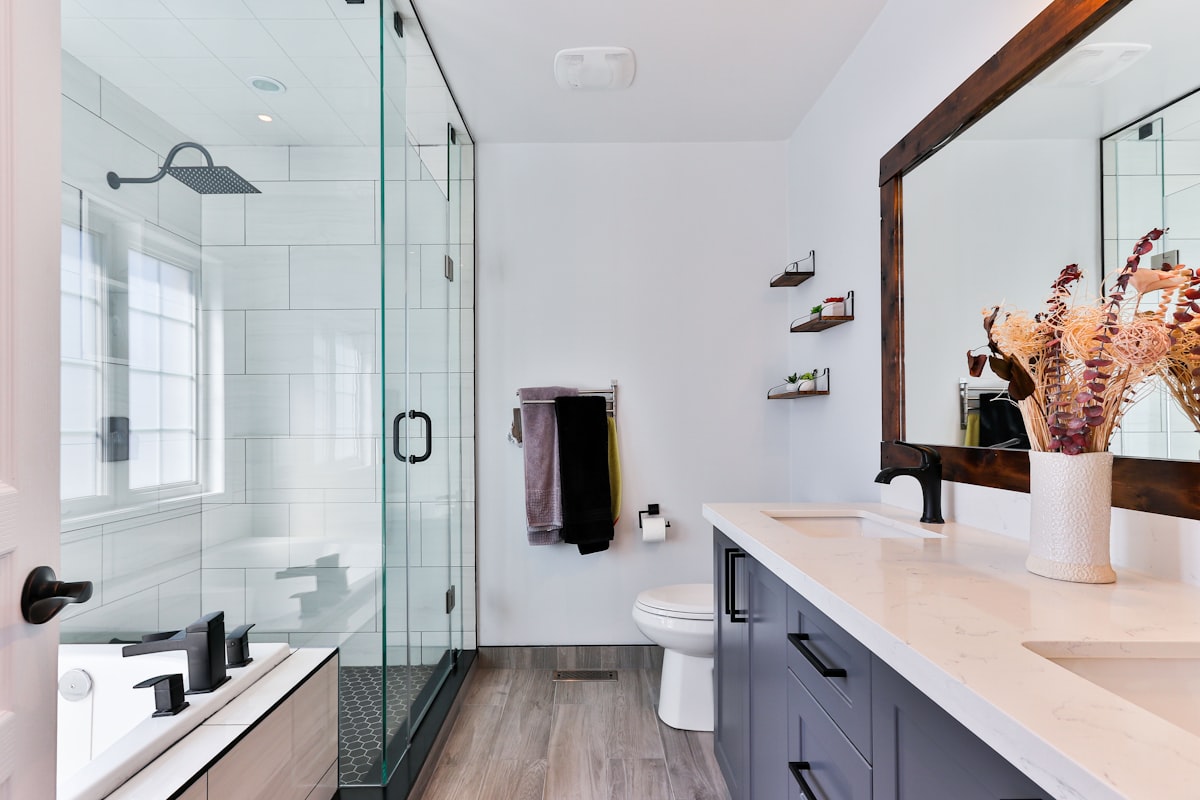 Frameless + white tile: the other flagship usePhoto: Unsplash
Cost Premium & the Worth-It Verdict
Low-iron is priced as a substrate multiplier — the thickness, edge work and tempering math all apply first, then the substrate premium lands on the glass portion. Typical 2026 US numbers:
| Product | Standard clear | Low-iron | Premium |
|---|---|---|---|
| Float glass sheet (cut to size) | $8 – $14 / sq ft | $11 – $22 / sq ft | +30–60% |
| 12 mm table top, polished | $18 – $30 / sq ft | $28 – $48 / sq ft | +55–70% |
| Frameless shower panel, 10 mm | $22 – $35 / sq ft | $32 – $55 / sq ft | +40–70% |
| Mirror (4–6 mm) | $6 – $10 / sq ft | $9 – $16 / sq ft | +30–60% |
| Aquarium pane, tempered | $25 – $45 / sq ft | $38 – $70 / sq ft | +50–60% |
💡 The verdict in one sentence: pay for low-iron when thickness or stakes are high — thick tops, rimless tanks, frameless showers, mirror walls — and keep standard clear where the glass is thin, framed, coated or curtained. The premium never buys strength or durability, only truth of color; if color truth doesn't reach the viewer, the money stays in your pocket.
Before ordering any of it, run the geometry: the Glass Size & Area Calculator turns your measurements into exact square footage (the number the premium multiplies), the Glass Price Calculator builds the full cut-to-size estimate, and every tool on the site lives in the calculators hub. For the weight check that decides delivery and install, the home page calculator is one screen away.
Low-Iron Glass FAQ
Can low-iron glass be tempered?▼
Yes — tempering is a heat treatment and works identically on low-iron float. A 'tempered low-iron' panel combines both upgrades: water-clear color plus 4–5× the strength and a safe dice-pattern break. It costs more than either upgrade alone (typically 1.8–2.6× standard clear glass) and has one planning constraint: the panel must be cut, edged and drilled before tempering, because tempered glass cannot be worked afterward. Frameless shower panels, thick table tops in homes with kids, and aquarium panes are the three places tempered low-iron is most commonly specified.
Does low-iron glass scratch more easily or break easier?▼
No and no. Low-iron differs from standard glass only in iron content — the surface is the same soda-lime silica with the same hardness (~5–6 on the Mohs scale) and the same annealed strength. Scratches come from what rubs the glass (grit, razors, abrasive cleaners), not from iron chemistry, and breaking behavior is set by thickness and heat treatment, not clarity. The persistent myth probably comes from low-iron's premium price implying a more delicate product; in fact, on a per-strength basis it behaves identically to the clear glass next to it.
Which aquariums actually need low-iron glass?▼
Reef and planted tanks, rimless and 'bookshelf' (bookcase-style) builds, and any tank where viewing is face-on at close range benefit most — coral and plant colors read truer and the water looks clearer, which is why reef hobbyists call it 'starphire' or 'optiwhite' glass. Fish-only freshwater tanks over 18 inches deep gain clarity too, since the water column itself absorbs red light. Where it matters least: dim tanks, outdoor ponds, and breeding or quarantine tubs, where standard glass loses nothing you were going to see anyway.
What does 'vidrio bajo en hierro' mean?▼
It is Spanish for low-iron glass — 'bajo en hierro' literally means 'low in iron'. Spanish-speaking suppliers may also call it vidrio ultraclaro or vidrio cristal claro. If you are sourcing in Latin America or Spain, ask for glass with hierro below 0.01% and a transmission above 91% at 4 mm; both numbers identify true low-iron regardless of the brand name a fabricator uses for it.
Is a 1/2" low-iron table top worth it over standard clear 1/2"?▼
On thick tops, yes — this is the single clearest use case for the upgrade. At 1/2" (12 mm), a standard glass edge shows a saturated green band roughly as dark as a wine bottle's base, visible from across the room on a polished edge. The same top in low-iron shows a nearly colorless, water-clear edge. The premium is a flat per-square-foot uplift rather than a thickness charge, so on a 36 × 60 in top expect roughly $150–350 extra depending on region — a visible, permanent difference on the one surface you look at every day.
Is low-iron shower glass worth the premium?▼
For frameless panels against white or light tile — usually yes, because that is exactly the setting where standard glass's green cast is most visible (large panel, white background, wet surface magnifying the tint). Against dark tile or textured glass, the upgrade disappears and the money is better spent on a better coating (clear nano sealant) that reduces water spotting. One clarification: 'low-iron shower glass' pairs the low-iron substrate with an untinted (clear, not green) float base — ordinary shower glass is often a tinted green-edge product, which is why cheap and premium panels look so different side by side.
Why is low-iron glass more expensive to make?▼
Iron enters conventional float glass from the sand batch, so removing it means sourcing ultra-pure, low-iron silica and refining the melt chemistry — the raw materials cost more and the melting process is less forgiving. The tank also cannot be cheaply switched between recipes, so low-iron lines run as dedicated campaigns. Those constraints, not marketing, explain the 30–60% premium; volume has slowly narrowed the gap, and the premium continues to shrink as low-iron becomes the default for premium architectural and display work.
Related Guides & Resources
Double Pane Windows Guide – IGU, R-Value, Triple Pane
Double pane windows guide covering IGU construction, gas fill, R-values, how to identify double glazing, and double vs triple pane comparison.
Fire Rated Windows Guide – 1 Hour vs 2 Hour Ratings
Fire rated windows guide covering rating grades, glass types, frame materials, and when to specify 1-hour vs 2-hour assemblies.
Window Measuring Guide – How to Measure Replacement Windows
Step-by-step window measuring guide: width, height and depth in the right order, inside vs outside mount, pane thickness for double glazing and square footage.
Custom Cut Mirrors Guide – Mirror Cutting Costs & Sizes
Custom cut mirror guide: thickness charts, edge and bevel pricing, where to get mirrors cut near you, and what a custom mirror really costs.
Window Pane Replacement Guide – How to Replace Broken Glass
Window pane replacement guide: diagnose the damage, then fix it right — single pane vs IGU steps, frame-type differences, gas-fill truth and real costs.